Project Summary
Between May and July 2025, the Yale Ancient Pharmacology Program (YAPP) conducted a multi-site fieldwork season across Central Greece, Italy, and Turkey, with each location contributing distinct yet interrelated data sets pertinent to our ongoing investigation into the chemical, cultural, and ecological dimensions of ancient medicine. Through a combination of ethnobotanical surveys and collection, multispectral and thermal imaging, and extensive vessel sampling for residue analysis, YAPP sought to add resolution to the rapidly developing map of material networks, both natural and manmade, by which medicinal knowledge and practice circulated in antiquity.
YAPP Team

The YAPP team brought together researchers at multiple levels of training and expertise:
- Undergraduate Students: Kierstin Gehres-Furgeson, Jamie Lattin, Micah Gold
- Graduate Researcher: Murphy Tu
- Botanist: Patrick Sweeney (Yale Herbarium, Museum Collections Manager)
- Program Leadership: Chris Renton (Program Manager), Andrew Koh (Principal Investigator, Museum Scientist)
The group was divided into two sub-teams with specific goals and priorities:
- The ethnobotany team (Gehres-Furgeson, Lattin, Renton, Sweeney) focused on field-based plant identification, ecological documentation, and specimen collection.
- The technology team (Gold, Tu, Koh) undertook aerial imaging efforts using thermal and multispectral sensors deployed via UAVs (unmanned aerial vehicles).
Central Greece
May 25–June 4
Centered in the modern town of Antikyra, our ethnobotanical work in Central Greece focused on the persistent populations and historical ecology of hellebore. Thought to possess both purgative and psychoactive properties, hellebore appears in a wide variety of Classical and Medieval texts, including medical treatises, imperial histories, and travelogues. The plant’s connection to the ancient town of Antikyra is characteristic of how place, plant, and pharmacology were integrated in the ancient world.

Over the course of ten days, the ethnobotany team documented and collected 16 hellebore specimens, alongside associated flora, from 11 distinct sites across Mount Parnassos, Mount Helicon, Mount Oeta, and the mountains above the ancient/modern city of Nafpaktos—regions that likely supplied much of the hellebore for production and consumption in ancient Antikyra. Surveys at Oeta and above Nafpaktos support a developing hypothesis that multiple towns bearing the name “Antikyra” in antiquity may have shared in a broader, hellebore-related cultural and economic identity.


4 images
Click to open gallery
These efforts enhance our understanding of hellebore’s current ecological niche and provide the phytochemical fingerprint we hope to uncover in future archaeological and legacy collection residue sampling. For the broader scientific community, these data could also raise important questions about how shifting climatic and human pressures may have altered the plant’s availability and potency. All collected specimens were gathered under government permit and duplicated for deposit with the University of Patras Herbarium, reinforcing our commitment to open data sharing and local collaboration.

Simultaneously, the technology team carried out UAV-based thermal and multispectral surveys in several key regions of cultural and ecological interest cited by ancient authors: the landscape surrounding Asklepeion and Iseion healing sanctuaries adjacent to Mt. Parnassos; the vibrant valley around the monastery of Hosios Loukas and the ancient city-state of Steiri—the potential gateway for the hellebore supply route from Mt. Helicon with ties to regional healing traditions; and the plant-rich mountains of Helicon and Parnassos themselves.
These datasets provide fine-resolution and comprehensive images that can non-invasively mark past cultural activities across vast areas and highlight specific spectral signatures of plants and surface pottery. They also support landscape interpretation and can guide future strategies for research in collaboration with local researchers such as the University of Patras Herbarium and the Boeotian Ephorate of Antiquities. The integration of UAV-based imaging into botanical and landscape fieldwork is a hallmark of YAPP’s interdisciplinary methodology.

Local support from Kyriaki Manika of Antikyra and academic collaboration with Prof. Maria Panitsa at the University of Patras were indispensable to the success of this season’s work, which builds on the long-standing support of local research collaborators Prof. Ioannis Liritzis of the University of the Aegean and Dr. Evi Tsota of the Boeotian Ephorate of Antiquities.
Falerii Novi, Italy
June 24–27
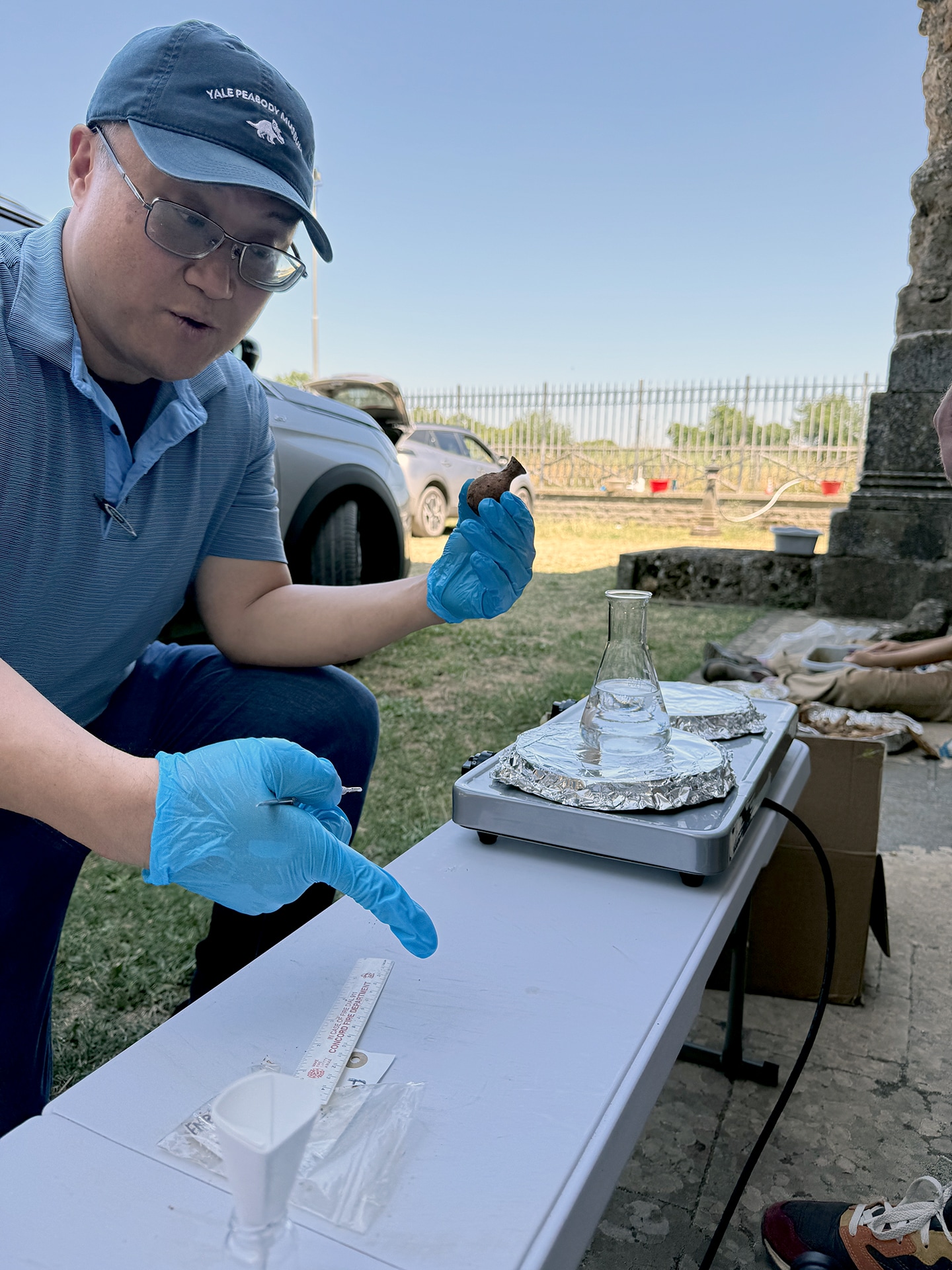
Following the work in Greece, Andrew Koh and Chris Renton traveled to Falerii Novi, a well-preserved Roman town site roughly 30 miles north of Rome, to pilot a targeted program of organic residue analysis (ORA) in collaboration with teams from Harvard University, the University of Toronto, and the British School at Rome, already excavating there. The YAPP team sampled over twenty vessels and hydraulic features, including two unguentaria—small flasks often used to store oils or perfumes—and a rare, intact amphora (of Phoenician tradition) from Roman Spain with visible residue inside, potentially indicative of a resinated wine concoction or a similar preserved liquid commodity.
The selection of vessels reflected a diversity of domestic, ritual, and commercial contexts, providing a potential snapshot of everyday Roman pharmaceutical, cosmetic, and culinary practices. Residue samples will be processed and analyzed in the YAPP labs in the coming months using gas chromatography-mass spectrometry (GC-MS) to reconstruct the chemical and cultural profiles of their precious contents.



3 images
Click to open gallery
Kültepe, Turkey
June 30-July 4
To conclude the summer field season, Koh and Renton visited Kültepe (ancient Kanesh), a major administrative and commercial hub of the Hittites and the Assyrian trading network in Central Anatolia. Here, the YAPP team partnered with Yale professor Gojko Barjamovic and Peabody curator Agnete Lassen to collect residue samples from over fifteen recently excavated ceramic vessels, representing both domestic and ritual contexts.


3 images
Click to open gallery

As one of the earliest urban settlements with continuous occupation and extensive textual records foundational to the Hittite Empire, Kültepe offers a critical opportunity to anchor YAPP’s pharmacological inquiries at the start of the second millennium BCE. Studying one of the earliest Indo-European complex societies prior to the rise of Mycenaean and Classical Greece, Kültepe serves as an ideal bookend to our work in Roman Italy. The integration of archaeochemistry into this text-rich archaeological context is still nascent, and YAPP’s collaboration with the Yale Babylonian Collection, the Near Eastern Languages and Civilizations Department, and the local excavation leadership marks an important step in filling a critical knowledge gap.
Integration and Outlook
The Spring–Summer 2025 field season beautifully demonstrates YAPP’s unique, transdisciplinary model: a networked approach to ancient pharmacology that emphasizes interdisciplinarity, mobility, and method-sharing across archaeological, botanical, chemical, and textual lines of inquiry. Each site contributes a distinct form of evidence, including living plants, buried vessels, and sensor-translated landscapes. But all are understood as interrelated archives of data and knowledge.

This year’s fieldwork benefited from the participation of undergraduate and graduate students, institutional partnerships, and local expertise. Laboratory analysis of samples is now underway and will inform future publications, excavation strategies, and student training.
As ever, YAPP remains committed to recovering, interpreting, and preserving the lost practices and understanding how they remain legible in the present.